Automated lamb leg deboning tech heading for Australian trial
Leg deboning looks like the next automation milestone, but the bone shapes, payback maths and plant size make it a harder sell than shoulder or chine.
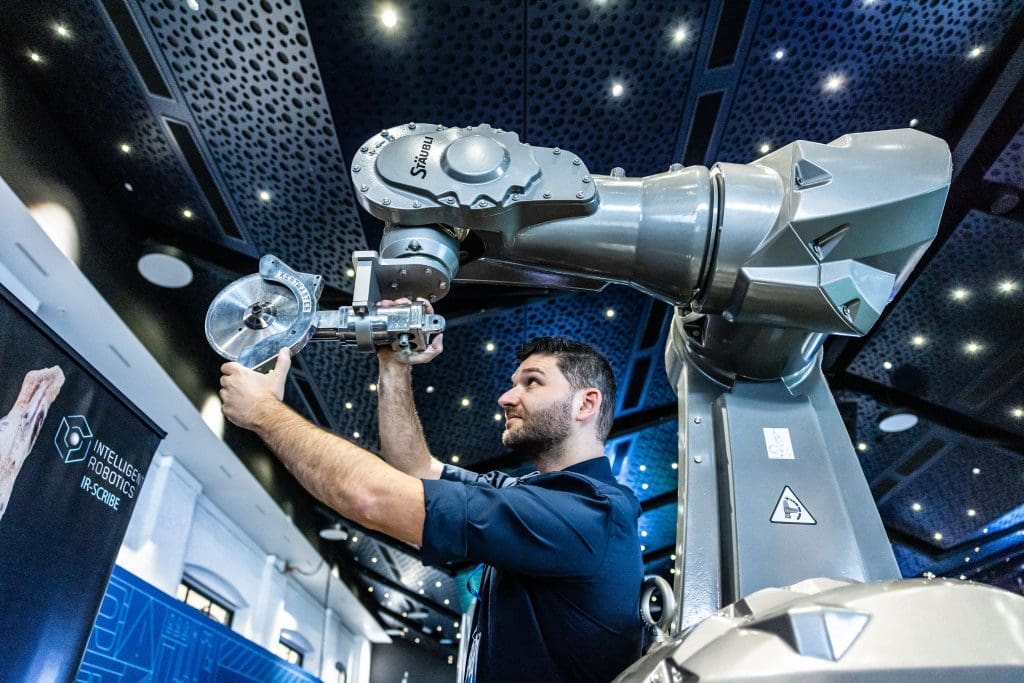
The assumption floating around processing circles is simple: if a machine can already strip the chine and separate a shoulder ribcage without a knife hand in sight, then automating the leg is just a matter of time and tweaking. Put the same robotic arms, the same vision systems, the same confidence on a leg carcase and the rest should follow. It won’t. The leg is a different engineering problem entirely, and the gap between a working prototype in a trial shed and a reliable line running three shifts a day in an export plant is where most of the real story sits.
Scott Technology’s work on chine boning and shoulder separation has already shown that automation can match manual performance on relatively predictable cuts, and that research funded through MLA and AMPC has pushed the sector a long way. But a lamb leg is not a shoulder with different proportions. It’s the part of the carcase where automation keeps stalling, and understanding why tells you more about the industry’s future than another “automation is coming” headline ever could.
The case for pushing ahead with leg automation
The argument for persisting is straightforward: labour is the single hardest input to secure in processing, and boning rooms are where plants bleed the most hours to short-term absenteeism, visa uncertainty and chronic musculoskeletal injury. Leg boning is physically repetitive, done at pace, and involves awkward wrist and shoulder angles that make it one of the more injury-prone stations on the chain. Anything that reduces that load, even partially, has an obvious occupational health and safety case, independent of the economics.
There’s also the yield argument. A skilled human boner is extraordinarily good at following bone contours by feel, but humans tire, and yield variability creeps in over an eight-hour shift. A machine with consistent force-feedback control and accurate vision guidance could, in theory, hold yield steady from the first leg of the day to the last. For an export plant processing large volumes, even a small, consistent improvement in meat recovery per leg compounds into a meaningful annual return, provided the throughput keeps pace with the line speed the rest of the chain is already running at.
The case for scepticism until the trial proves it
The sceptical case rests on biomechanics the industry has not solved yet. The chine is a relatively flat, predictable structure to separate. A shoulder, while more complex, still presents a ribcage that separates along a fairly consistent plane. The leg is different: the femur, tibia and associated joint capsule vary in angle and length between carcases far more than the bones automation has already conquered, and the leg carries a dense network of tendons and ligament attachments around the knee and hip joint that must be cut cleanly without nicking the bone or tearing the surrounding muscle. Get the angle of approach wrong by even a few degrees and you either leave meat on the bone, costing yield, or score the bone itself, costing presentation and value.
That means a leg system needs sensing well beyond what chine and shoulder automation required. Vision alone can map the external shape of the leg, but it can’t see where the tendon attaches to the bone beneath the surface, so systems in development lean on a combination of X-ray or similar imaging to map bone position before the cut, plus real-time force-feedback so the blade or robotic tool can adjust pressure and angle as it meets resistance it wasn’t expecting. Carcase-to-carcase variation in fat cover, muscle size and bone curvature then becomes the real test, not the demonstration animal picked because it behaves well in front of visitors.
The hardest part of automating a lamb leg isn’t building a robot that can cut bone — it’s building one that can tell, in real time, exactly where the bone is going to be before the blade gets there.
What “success” actually has to look like
A trial that simply proves a robot can separate a leg from bone under controlled conditions is not the same as a trial that proves commercial viability. For an Australian pilot to be taken seriously by plant operators, it realistically needs to demonstrate three things over a sustained run, not a single shift: throughput that matches or approaches the line speed of an experienced manual boning team, yield recovery at least equal to manual benchmarks rather than merely close to them, and consistency across a genuinely mixed batch of carcases rather than a pre-sorted, uniform sample. Past chine and shoulder projects have stumbled exactly here — a system that performs beautifully on selected carcases in a test environment can fall over once ordinary day-to-day variability in carcase size and conformation is introduced on a live line.
Timeline-wise, the gap between “trial” and “commercial rollout” has historically been measured in years, not months, precisely because of this gap between controlled performance and line-ready reliability. Expect the Australian trial to be judged less on a single headline result and more on whether it can hold its numbers steady across weeks of varied throughput.
Who this technology still won’t suit
Even a successful trial won’t make leg deboning automation universal. The capital outlay for a system combining robotics, imaging and force-feedback control is substantial, and it only makes financial sense where volume is high enough to amortise that cost against labour and yield savings over a realistic payback period. Large export-oriented plants running high, consistent throughput are the obvious candidates. Small and mid-sized abattoirs, particularly those processing mixed consignments with wide variation in carcase size, breed and conformation, are a much harder fit — the variability that trips up automated systems is exactly what these smaller operators deal with daily, and they lack the volume to justify the investment regardless.
There’s also a workforce question that doesn’t resolve neatly into “jobs lost.” The realistic expectation isn’t full replacement of boning room staff but a shift in roles — fewer hands on the physically repetitive cutting stations, more oversight, maintenance and quality-control positions around the machinery itself. Injury rate reduction is the headline benefit processors will chase, but it depends on the system actually handling the hardest, most injury-prone cuts reliably, not just the easier ones.
| Push ahead now | Wait for proven reliability | |
|---|---|---|
| Best suited to | Large export plants, high consistent volume | Small and mixed-consignment abattoirs |
| Main technical risk | Bone and tendon variability causing yield loss or bone scoring | Avoided until sensing (X-ray plus force-feedback) matures |
| Labour effect | Fewer boning hands, new technical/maintenance roles | Status quo, ongoing injury exposure continues |
| Capital exposure | High upfront cost, needs volume to pay back | None, but risk of falling behind competitors |
| Trial benchmark needed | Throughput and yield matching manual across mixed batches | Watching for sustained multi-week performance data |
The honest verdict is that leg deboning automation deserves the trial, but not the premature confidence that chine and shoulder success might invite. The mechanics are harder, the sensing requirements are more demanding, and the economics only work for a narrower slice of the industry than headlines tend to suggest. Large, high-volume export processors have real reason to watch this trial closely; smaller and mixed-throughput operators have equally good reason to let someone else carry the early risk. What happens over the coming trial period — not the announcement of it — is what will actually decide whether this becomes standard plant equipment or another promising prototype that quietly stalls.
Where do you think the line should be drawn between plants that should invest early and those that should wait?

Flock & Breeding Desk
Writing on breeding, lambing, nutrition and day-to-day flock management for Wiltshire Horn producers.