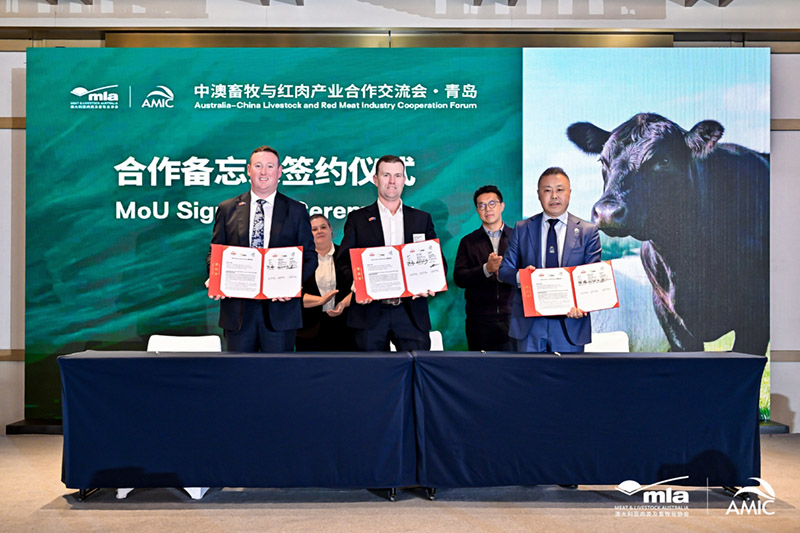
Australia-China red meat partnership strengthens through industry exchange
An MoU sounds like a breakthrough, but it changes none of the tariffs, quotas or plant suspensions that actually move farmgate prices.
A grazier in southern Queensland scrolls past the headline on his phone while waiting for the next pen of steers to come through the ring. “Australia-China red meat partnership strengthens” sounds like good news for the cheque he’s about to get. He’s seen headlines like this before, though, and he’s also seen the ones where a processing plant loses its China listing overnight and the saleyard price drops the same week. So which one is this?
The short answer is that a memorandum of understanding between industry bodies is real, but it is not a trade deal, and it does not by itself move a single dollar into anyone’s bank account. What it does, and does not, commit each side to is worth spelling out plainly, because the gap between what gets signed in Beijing and what shows up at the saleyard is exactly where producers get caught out.
Myth: An MoU Is a Binding Trade Agreement
A memorandum of understanding between industry associations is a statement of shared intent, not a treaty. It is signed by sector bodies representing meat processors and producers, not by national governments, and it carries no legal obligation to buy, sell, lower a tariff or approve a plant. What it commits each side to is cooperation activity: joint forums, technical exchange, study tours, information-sharing on things like feedlot management, breeding genetics and cold-chain logistics. That is genuinely useful groundwork for relationships, but it is categorically different from a government-to-government trade instrument that changes market access rules. If a reader takes one thing from this article, it should be that an MoU can strengthen goodwill and open doors to conversations, while leaving every tariff schedule, quota and plant registration exactly where it was the day before.
The real test of any industry partnership is not the signatures on the page but whether it changes what happens at the border the next time there is a political disagreement.
Myth: This Guarantees Higher Prices for Australian Producers
Farmgate prices are set by the interaction of global supply, domestic competition among buyers, currency movements, seasonal conditions and actual shipped volumes, not by the existence of a cooperation agreement. An MoU does not create new demand in China, it does not force Chinese importers to pay more, and it does not insulate Australian producers from a strong season in Brazil or the United States pushing global supply up. Where this kind of exchange can matter over time is indirectly: better relationships and more technical dialogue can make it easier to resolve disputes over plant suspensions or documentation issues faster than they would otherwise be resolved, and faster resolution of a suspension is worth real money to the exporters affected. That is a meaningful but modest effect, and it is not the same as a price floor.
Myth: China Hasn’t Restricted Australian Meat Before, So Nothing Has Changed
This ignores a recent history that still shapes how the industry thinks about any China announcement. Several Australian red meat processing plants have had their listings suspended by Chinese authorities at various points over recent years, often tied to technical compliance issues but widely read in the industry as linked to broader diplomatic tension. Barley, wine, coal and other commodities also faced tariffs, anti-dumping duties or informal import slowdowns during the same period of strained bilateral relations. Red meat trade continued throughout, but individual processors absorbed real disruption when their specific plant lost access, even while competitors down the road kept shipping. An industry exchange like this one is better understood as part of a broader thaw in the relationship following that period of tension, not as evidence the underlying vulnerability has disappeared. The mechanisms that caused plant suspensions in the past, customs discretion, biosecurity technicalities, political signalling, are all still fully intact and sit entirely outside what an MoU between industry bodies can touch.
Myth: Every Australian Exporter Benefits Equally
Market access to China is administered plant by plant, not industry by industry. A processor only ships to China if its specific facility is registered and currently listed, and delegation visits, forums and technical exchanges tend to involve the larger, already well-connected exporters who have the relationships and resources to participate in Beijing study tours in the first place. Smaller regional processors without an existing China listing, or without the scale to send representatives on week-long delegations, gain little directly from this kind of exchange. They remain reliant on whatever general improvement in bilateral sentiment trickles down, without having had a seat at the table that produced it. The practical effect is that cooperation agreements tend to reinforce the position of exporters who are already established in the China market rather than open genuinely new access for those who are not.
| What the MoU plausibly affects | What it does not affect |
|---|---|
| Industry-to-industry dialogue and trust | Tariff schedules under existing trade agreements |
| Speed and clarity of technical communication | Plant-by-plant registration and listing status |
| Knowledge transfer on breeding, feedlotting, cold chain | Anti-dumping rulings or customs enforcement discretion |
| Goodwill ahead of future negotiations | Global supply and demand that sets farmgate prices |
Myth: Sharing Expertise Only Helps Australian Exporters
This is perhaps the least examined part of these exchanges. Delegations touring Chinese breeding operations, feedlots and processing facilities are not a one-way flow of Australian goodwill into a passive host market. China has been actively investing in its own domestic beef and sheep meat production capacity, including large-scale feedlotting and improved breeding programs, partly as a deliberate strategy to reduce long-term reliance on imports. Technical exchange that helps Chinese operations lift productivity, improve genetics or adopt better feedlot management is, in effect, assistance toward that same goal of import substitution. None of this makes the exchange dishonest or one-sided by design, both industries have legitimate reasons to want the relationship to work, but Australian producers should not assume that closer cooperation on livestock production automatically means a permanently larger slice of the Chinese market for Australian product. If anything, the more successful China is at building its own supply chain with the help of international technical knowledge, the more Australian exporters may eventually be competing against cheaper, closer domestic supply rather than complementing it.
Myth: Red Meat Trade Volumes Are Set to Jump Because of This Exchange
Trade volumes respond to tariff schedules, quota arrangements, currency movements, Chinese consumer demand and competing supply from other exporting nations such as Brazil, the United States and South America more broadly. An industry forum, however well attended, does not change any of those variables on its own. What it can do is lay groundwork, clearer technical standards, faster dispute resolution, stronger personal relationships between industry figures, that may make future negotiations smoother. Producers reading this kind of announcement should treat it as a signal of relationship repair worth watching, not as a forward indicator for next quarter’s cattle or sheep prices. The numbers that actually move those prices will keep being set, as they always have, by supply, weather, currency and the state of competing export markets, regardless of how many delegations cross the border in either direction.

Shows & Events Desk
Reporting from the show ring — results, schedules and tips to get your Wiltshire Horns show-ready.