Australia’s winter crop harvest forecast ‘large but lower’
The national decline hides a split story: some regions are parched, others are set for a near-normal year.
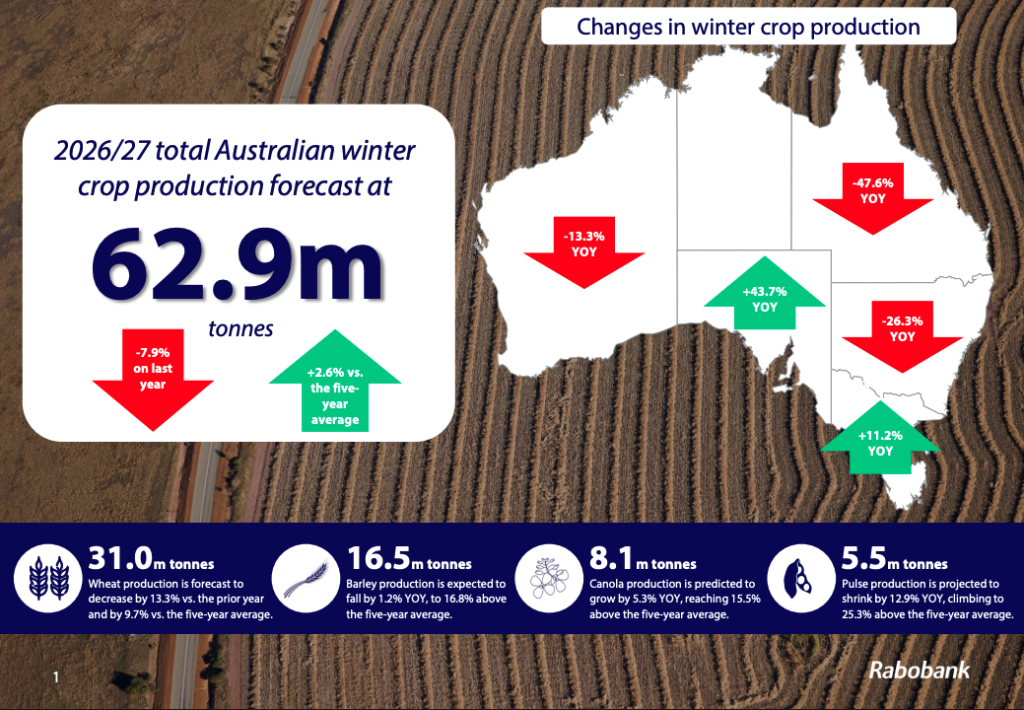
A grain marketer in a Melbourne office pulls up two agronomy updates side by side on a Tuesday afternoon. One, from a contact in the Western Australian wheatbelt, describes paddocks that never got a proper break to the season and crops that are already being written down. The other, from a grower near the Victorian Wimmera, describes subsoil moisture that is close to ideal and a canola crop that could end up among the better ones in years. Same national forecast. Two completely different seasons. That gap, more than the headline tonnage, is the real story behind this year’s winter crop numbers.
The national read is already known: a winter crop that is still large by historical standards but down on last year, with planted area falling by roughly seven to eight per cent to somewhere between 23.1 and 23.6 million hectares, a few percentage points below the five-year average. Mixed seasonal conditions get the blame in every summary. What rarely gets explained is where those conditions actually bit, which crops absorbed the hit, and what it means for the person deciding right now whether to top-dress a paddock or lock in a forward contract.
Where the decline is actually concentrated
The national area figure is a blend, and blends flatter extremes. In practice, the pullback this year is not spread evenly across the country. Western Australia, which usually contributes the largest single share of the country’s wheat and canola area, has been the region most exposed to a late or patchy break to the season, and dry pockets in South Australia’s mid-north and Eyre Peninsula have added to the downgrade. Those two states together carry a disproportionate amount of the area reduction, because growers there made real-time decisions to cut back on canola and chickpea plantings when the opening rains didn’t arrive on schedule, switching some ground to lower-input cereals or leaving paddocks fallow rather than risk a poor establishment.
Eastern Australia tells a different story in parts. Northern New South Wales and southern Queensland have had their own dry stretches, but central and southern New South Wales, along with much of Victoria, went into the season with reasonable subsoil moisture reserves built up from earlier rain. That cushion means the eastern states’ contribution to the national decline is smaller than it would otherwise be, and in some districts plantings have held close to normal.
Wheat holds, canola and pulses give ground
Breaking the national tonnage down by crop matters because wheat, barley, canola and pulses do not respond to a dry start the same way. Wheat is the crop growers protect first, because it is the most flexible to sow later and the most central to farm cash flow, so wheat area has generally been defended even where conditions were marginal. Barley, which often competes with wheat for the same paddocks, has tended to hold up reasonably as well, partly because malting and feed demand gave growers a reason to keep the crop in rotation.
Canola and pulses have worn more of the cutback. Canola needs a reliable early break to establish well, and in areas where that break was late or light, growers reverted to cereals rather than risk a costly canola failure. Chickpeas and other pulses carry their own disease and frost risk in a wetter or uncertain finish, which makes them an easier crop to trim when a season starts uncertainly. The practical result is that the national area decline is not a uniform shave across every crop; it is disproportionately a canola and pulse story layered on top of a more modest wheat and barley pullback.
What this means for flour, feed and the supply chain
The question buyers and households actually want answered is whether a smaller crop translates into a domestic shortage of wheat or higher flour prices through 2026. The honest answer is that an outright shortage is unlikely. Australia remains a major wheat exporter even in a lower year, and the forecast, while down on the prior season, still sits well above the kind of drought-year harvests that have genuinely strained domestic supply in the past. Millers and bakers source under long-term contracts and typically hold enough carryover stock to smooth a single lower year.
What is more plausible is firmer pricing at the margin. A tighter exportable surplus tends to lift the price Australian millers pay relative to a bumper year, because less grain is competing for buyers domestically and growers have more leverage to hold out for better offers. Feed grain users, including intensive livestock operations, are often the first to feel this, since they compete directly with export demand for the same tonnes. Consumers are unlikely to see a dramatic jump at the checkout from this factor alone, but bakers and food manufacturers working on thin margins will be watching input costs more closely than usual.
The growers who won’t feel it
Not every operation is exposed to this downgrade. Irrigators along the Murray and in parts of the Riverina are largely insulated from a dry start, because they can water a crop into establishment regardless of what the sky delivers. Growers on heavier clay soils with strong moisture-holding capacity, particularly through central New South Wales and the Victorian Wimmera and Mallee, went into the season with enough stored moisture to sow on schedule and are tracking toward average or better yields. For these growers, the national headline understates how normal their season actually looks.
Decisions on the table now
For growers still finalising inputs, the practical calculus has shifted. Locking in forward contracts on wheat makes more sense this year than in a bumper season, given the likelihood of firmer pricing. Growers with marginal canola country are weighing whether to chase a late canola price premium or stick with the safer cereal they’ve already committed to. Buyers further down the chain, from feedlots to flour millers, are reviewing supply contracts earlier than usual rather than assuming grain will be freely available at harvest.
- The national area decline is concentrated in Western Australia and parts of South Australia, with eastern states holding up better due to stronger subsoil moisture.
- Canola and pulses have absorbed more of the cutback than wheat and barley, which growers tend to protect first.
- A domestic wheat shortage is unlikely; firmer pricing for millers and feed users is the more realistic outcome.
- Irrigators and growers on moisture-retentive soils in parts of New South Wales and Victoria are tracking close to average yields.
- Forward contracting wheat and reassessing canola and pulse plantings are the live decisions facing growers right now.
Back in that Melbourne office, the marketer closes both agronomy reports and starts drafting a note to clients. The headline number will say the harvest is large but lower. The note underneath it will say something more useful: which paddocks are carrying that shortfall, which ones aren’t, and what both of those things are about to do to price.

AWHSA Editorial
The editorial desk of the Australian Wiltshire Horn Sheepbreeders Association, covering breed news and association updates.