Eedy Doorman Fame makes history at FBD National Dairy Show
Three titles, two conflicting scores, and a "year off" — here's the math and judging logic behind the record, explained plainly.
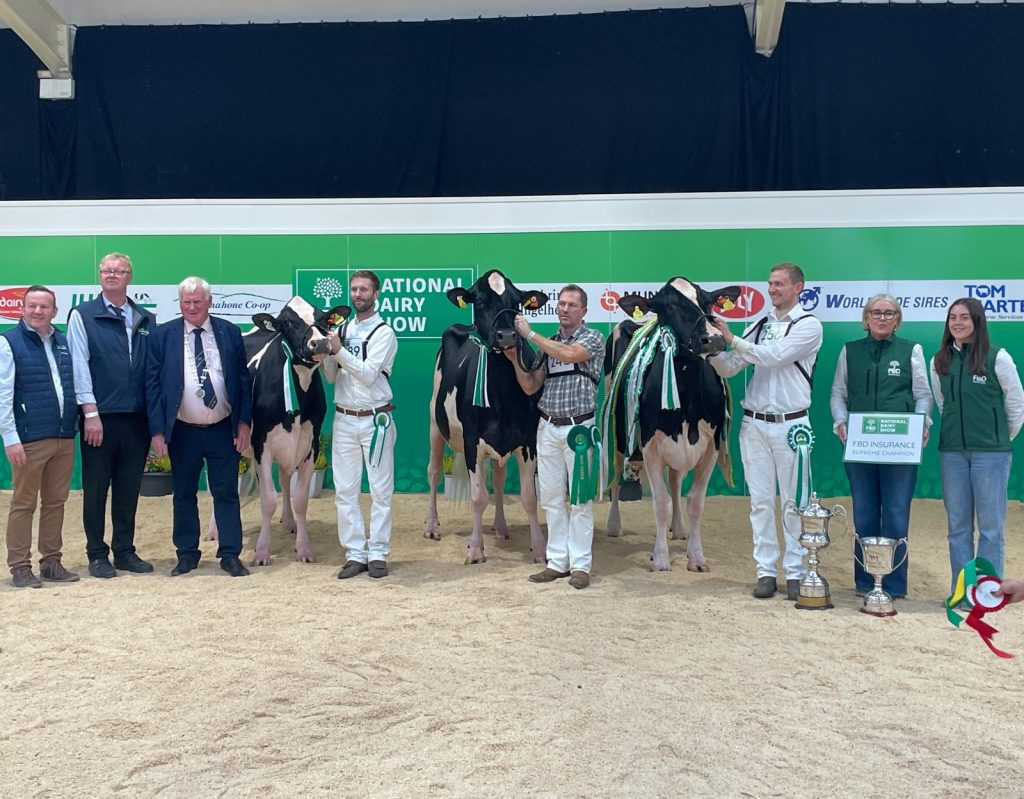
Here’s the detail that trips people up: two different reports of the same cow’s final classification score can’t both be right, yet both numbers have been printed as fact. One says Eedy Doorman Fame sits on an EX96 2E. Another says she’s EX97. If you’ve been trying to figure out which one actually belongs on the record books, you’re not imagining the contradiction — and the answer tells you more about how classification works than either number does on its own.
Eedy Doorman Fame, bred and owned by the Helen family of Clonakilty, Co. Cork, has just become only the second animal ever to win Supreme Champion at the FBD National Dairy Show three times. That part isn’t in dispute. What’s worth untangling is everything underneath it — the score, the age, the gap year, and how she actually stacks up against the cow she’s now bracketed with in the record books, Moralta Inspiration Fame.
So which score is correct — EX96 2E or EX97?
Classification isn’t a one-off exam. A cow is scored by a classifier on a visit, and that score can be revised upward on a later visit if she’s improved — udder depth, mammary attachment, feet and legs, the lot are all reassessed as she matures through lactations. A score given mid-lactation two or three years ago can genuinely be superseded by a fresh visit this year.
That’s almost certainly what’s happened here. EX96 2E reflects an earlier classification point in her career — a very good score in its own right, since EX is already the top band and “2E” denotes excellent status held across more than one classification. EX97 is the current, more recent figure, and under the scale used in Ireland and the UK, it’s about as close to the ceiling as cows get. A handful of animals ever reach it. If you’re trying to decide which number to trust, trust the later one — classification moves in one direction for a cow on top form, and 97 is the forward step from 96.
The “year off” — what late calving actually does to a show cow
You’ll have seen it mentioned that Eedy Doorman Fame had a year off the show circuit in 2025, tied to calving late. That’s not a euphemism for being retired or rested by choice — it’s a mechanical consequence of how show eligibility and milk production line up.
Cows are shown relative to where they are in lactation, because udder shape, fullness and overall “bloom” change dramatically across the lactation curve. A cow that calves late relative to a show’s calendar date can end up either far too fresh (udder not yet settled into shape) or too far into lactation (milk yield and udder fullness dropping off) to present at her best on the day that matters. Breeders will often simply skip a show year rather than present a cow who isn’t at her physical peak, because a below-par appearance can do more harm to a show cow’s reputation than sitting a year out ever will.
So “year off” doesn’t mean illness, retirement, or a step back in quality. It means the calving date and the show date didn’t line up, and the sensible call was patience.
Fifth-calver or seven-year-old? Both, and here’s the math
This is the one that looks like an error but isn’t. A Holstein heifer typically calves for the first time at around two years old. If she calved like clockwork every twelve to thirteen months after that, a cow would rack up five calvings by roughly age six to six and a half.
Eedy Doorman Fame is reported as both a seven-year-old and a fifth-calver — and the gap between those two numbers is explained precisely by the year-off story above. One extended calving interval, whether through a late conception, a deliberately managed rest, or simply nature not cooperating on schedule, stretches the gap between calving five and where you’d otherwise expect her to be. Lose a year somewhere in the middle of a five-calving career and your parity number falls behind your age number by roughly that same year. The two figures aren’t contradicting each other — they’re both true, and the gap between them is the story of 2025.
Calver-by-calver against Moralta Inspiration Fame
The comparison everyone’s drawing is with Moralta Inspiration Fame, the only other cow to have won this title three times. What makes the comparison meaningful isn’t just the tally of wins — it’s that both cows built their reputation calving by calving rather than off one spectacular freshening.
A show cow’s career is really a series of separate auditions. Each calving resets the clock: new udder, new lactation curve, a fresh chance to be marked up or down at classification. A cow who wins Supreme Champion once off a standout first or second lactation is impressive. A cow who does it three times, across different calvings and different stages of physical maturity, is proving something closer to consistency of type — that the frame, the mammary system and the overall balance hold up as she ages, rather than peaking once and fading. That’s the real echo between the two cows: not just the win count, but a career built on repeatable quality calving after calving, which is a far harder thing to breed for than a single great lactation.
What “tapped out” actually means if you’ve never stood ringside
If you’ve read that a judge “tapped out” a cow for the title, here’s the plain version. As the judge works through the line of animals in the ring, they physically touch or tap the cow they’re pulling forward — out of the lineup and ahead of the others — to signal placement. The final tap, at the very end of the process, is the one that names the champion. It’s a visual, almost theatrical moment precisely because everyone ringside can see the decision land in real time, rather than waiting on a printed card.
The takeaway: every seemingly conflicting detail about Eedy Doorman Fame — EX96 versus EX97, “seven-year-old” versus “fifth-calver,” the mysterious year off — resolves the moment you understand classification is ongoing, calving intervals aren’t fixed, and show eligibility depends on timing as much as quality. None of it is an error. It’s just a career told through numbers that update as she does.

AWHSA Editorial
The editorial desk of the Australian Wiltshire Horn Sheepbreeders Association, covering breed news and association updates.