Further bluetongue cases confirmed in Ireland
Ireland's 28 herd cases are small next to NI and GB outbreaks, but movement rules, vaccine gaps and trade risk need action now.
It’s dusk on a cattle farm in south Wexford, and the midges are up over the slurry tank in a thin grey haze. A farmer walks the paddock fence one more time before dark, not looking for a broken wire this time but for anything that looks off in the herd — a drooped head, a swollen lip, a limp. That nightly check has changed in the past few weeks, even though nothing about the animals themselves has changed yet.
The short version: Ireland’s bluetongue situation is still containable, but only if farmers treat restricted zones, testing and midge control as active jobs starting today, not after the next case is confirmed.
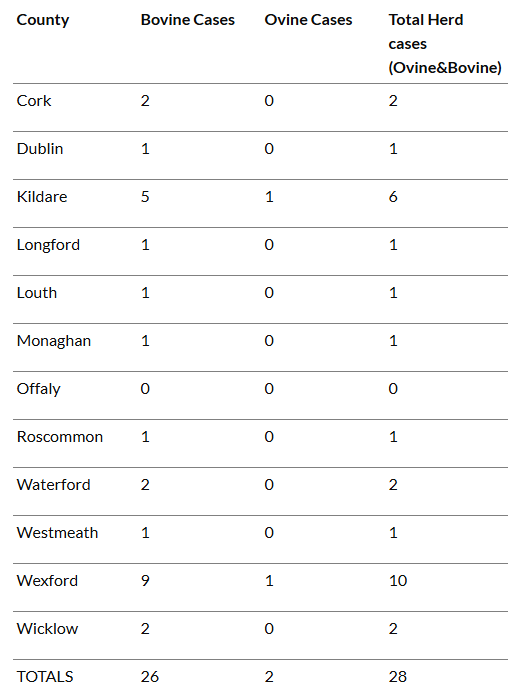
Twenty-eight herd cases across 11 counties, mostly cattle, concentrated in Wexford and Kildare, is the number doing the rounds. On its own it tells a farmer very little about what to actually do. Set against Northern Ireland’s 44 cases inside a single herd, and England’s outbreak running into the thousands, the Irish picture looks different — and what you should do about it depends on separating what’s confirmed from what’s assumed.
Myth: 28 cases here is the same kind of outbreak as in GB
It isn’t, and the difference in pattern matters more than the difference in raw numbers. Northern Ireland’s 44 cases sitting inside one herd suggests a single, intense point of infection — a localised midge population hitting one site hard. England’s thousands of cases reflect sustained, widespread midge activity over a much longer transmission season, the kind of scenario a seasonal bluetongue spread model in cattle describes as a large first epidemic peak once the seasonal reproduction number climbs above 1 — essentially, once midge abundance lets each infected animal pass the virus on to more than one other. Ireland’s 28 cases, spread across 11 counties rather than clustered, look more consistent with scattered introduction than runaway local spread, at least for now. That is not a guarantee it stays that way; it is a reason the next few weeks of midge activity and testing results matter more than the current headline total.
Myth: a restricted zone means my herd is locked down
A restricted zone does not stop farming; it stops uncontrolled movement. In practical terms, animals inside a control or restricted zone can usually still move within that zone, but moving stock out of it — to a mart outside the zone, to a factory outside the zone, or for export — triggers testing, documentation or an outright ban depending on destination. The costliest part isn’t the paperwork, it’s the knock to normal selling patterns. A French study of the 2006 bluetongue movement restriction policy found that farmers inside the restricted zone sold 21% fewer animals than they otherwise would have during the restriction period, because calves and cattle that would normally have gone to market got held back on-farm instead. That 21% drop is a direct measure of restricted animals piling up on the farm — extra feed costs, extra space, and a backlog of sales once restrictions lift. An Irish farmer inside a current zone should assume a similar bottleneck is possible and plan housing and feed budgets accordingly, rather than waiting to see if it happens.
Myth: there’s a vaccine ready and farmers should get it into animals immediately
This is the one where caution matters most. Vaccination against bluetongue works, but it has to match the circulating strain, and a vaccine built for one serotype does little against another. The seasonal spread model found that vaccination reduced the seasonal reproduction number and cut the size of the epidemic peak substantially when coverage was high — but that result was modelled for BTV-8, not the BTV-3 strain now confirmed in Ireland. Belgium’s experience with BTV-8 is the closest real-world comparison available: a Belgian cost-sharing vaccination programme study found that a subsidised, voluntary vaccination scheme meaningfully increased uptake among herd owners and was judged cost-beneficial for maintaining disease-free status once the virus was established in the region. The lesson isn’t “vaccinate now” — it’s that vaccination only pays off once a BTV-3-matched product is actually available and recommended for Irish conditions, and farmers should be watching for that confirmation rather than assuming any bluetongue vaccine on a shelf will do.
The single most important fact right now is that the speed of Ireland’s spread, not the current case count, will decide whether this stays a containable cluster or turns into a GB-style outbreak.
Myth: the trade hit only applies to animals being exported live
Movement restrictions bite beyond live export lorries. Once a zone is designated, buyers elsewhere — including factories and marts outside the zone — can become reluctant to take stock from it even where testing technically permits movement, simply to avoid their own downstream restrictions. That reluctance is exactly what drove the 21% sales drop in the French data above: it wasn’t a legal export ban alone, it was a chain reaction of caution along the supply chain. For Irish suckler and beef farmers in Wexford, Kildare or any newly affected county, the realistic financial risk is reduced competition at point of sale rather than a total closed door, which still means lower prices for animals that do move.
Myth: testing only matters once a case is suspected
Passive surveillance — vets and farmers reporting sick animals — catches bluetongue only once symptoms appear, and bluetongue can circulate quietly in cattle before anyone notices. A cost-effectiveness study of bluetongue surveillance design found that under the assumption the disease shows clinical signs, passive clinical surveillance alone could establish freedom from disease with near certainty over a year — but that result depended heavily on farmer and vet disease awareness, and additional active surveillance (routine blood sampling, not just waiting for sick animals) was only worth the cost once prevalence was expected to be very low. Ireland’s first detection, in January 2026, came from routine surveillance blood samples, not a sick animal — proof the quiet-circulation risk is real here. For a farmer in an affected county, that argues for asking your vet about periodic blood testing now, rather than waiting for visible illness.
Myth: there’s nothing practical to do before a vaccine or more cases arrive
Midges are the actual vector, and a network model of bluetongue spread across French cantons found that both midge flight and animal movement between areas drove transmission, meaning cutting either route slows spread. Practical, doable steps now: housing animals at dusk and dawn when midges are most active, using insecticide/repellent treatments recommended by your vet, avoiding unnecessary movement of stock through or from affected counties even where currently legal, and increasing the frequency of visual herd checks for early signs — swelling, lameness, drooling — so any new case is caught and reported fast under the notifiable disease rules already in place.
Sources
- Optimising cost-effectiveness of freedom from disease surveillance — Bluetongue Virus Serotype 8 as an example (2018)
- Effectiveness and cost-benefit study of a cost-sharing vaccination programme against bluetongue serotype-8 in Belgium (2019)
- Seasonal spread and control of Bluetongue in cattle (2011)
- Cost assessment of the movement restriction policy in France during the 2006 bluetongue virus episode (2014)
- A network-based approach to modelling bluetongue spread in France (2019)

Shows & Events Desk
Reporting from the show ring — results, schedules and tips to get your Wiltshire Horns show-ready.