Kiwis’ wings clipped by Aussie blades in historic shearing match
A rare Australian blade-shearing win raises a real question: how is the sport actually scored, and why has New Zealand ruled it for 15 years?
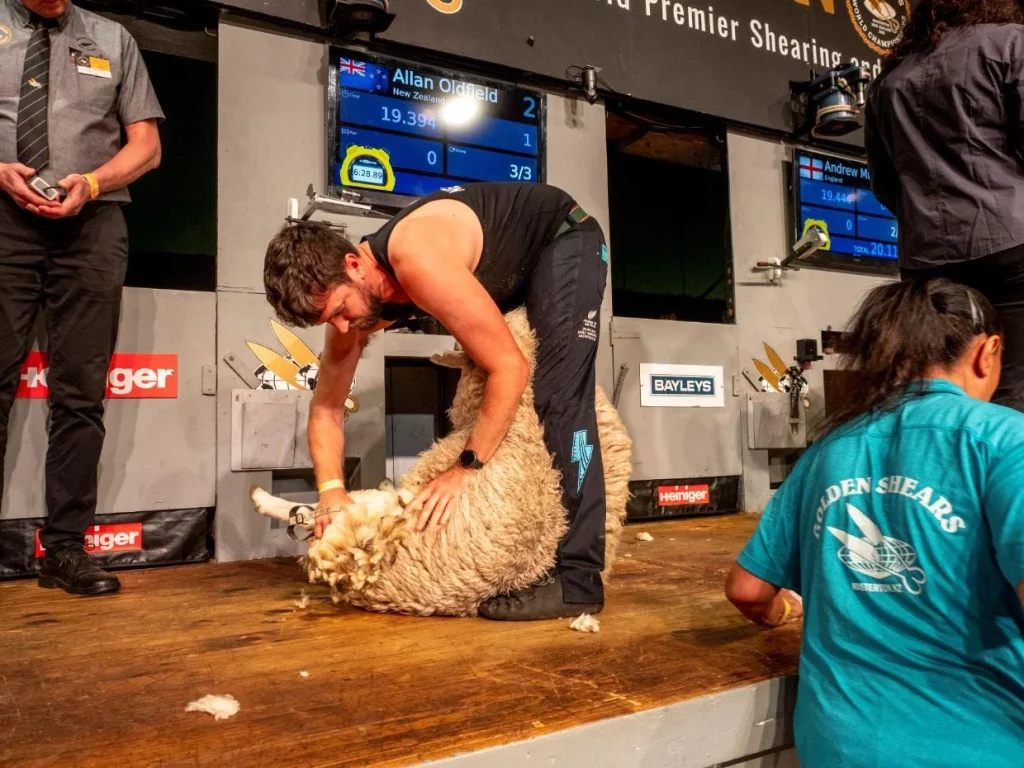
There is no engine note in blade shearing. No comb-and-cutter whine, no compressed air hissing down a line of handpieces. Just the scrape and snip of hand shears working through a fleece, judges bent low over each sheep’s skin checking for nicks, and a scoreboard that will not be settled by the clock alone. At Waimate, that quiet discipline produced a result rare enough to stop regulars in their tracks: an Australian pair out-pointed New Zealand’s best on New Zealand soil, by a margin of 2.813 points. To understand why that number matters more than the final placing, you need to know what actually goes into it.
- Blade shearing is scored on a combined system, time and quality together, not speed alone — which is why a result can flip on points even when both pairs finish close together.
- Quality judging covers evenness of cut, missed wool, second cuts and skin damage, with penalties added onto a time-based score — a tougher, slower, more exacting craft than machine shearing.
- Australia has now won only twice in 21 transtasman blade tests since 2010, underlining just how total New Zealand’s grip on this discipline has been.
- The win does not erase a mixed transtasman season overall, since New Zealand took the machine-shearing series in Australia 2-1 the same year.
What the 2.813-point margin actually measures
In blade shearing, as in machine shearing competitions generally, the raw time a pair takes to shear their sheep is only half the equation. Judges separately assess the quality of every sheep shorn, walking the board afterward and running a hand over the skin and fleece looking for unevenness, wool left on the sheep, cuts made twice over the same patch of skin known as second cuts, and any nicks or cuts to the skin itself. Each fault attracts a penalty, and those penalty points are added to a time-based score to produce the final tally. The lower the combined score, the better — so a pair can finish shearing their sheep in good time and still lose if the judges mark them down heavily on quality, while a slightly slower pair with cleaner, more even work can come out ahead.
That is almost certainly the story behind the margin at Waimate. A gap of 2.813 points is not a canyon in this kind of scoring; it is the sort of difference that typically comes down to a modest number of quality penalties rather than one side being dramatically faster across the board. It reflects the nature of blade work itself: because the blades cut more slowly and far more deliberately than a machine handpiece, elite pairs tend to finish within a reasonably tight window of each other on time, which means the quality assessment — the nicks avoided, the wool left clean and even, the absence of second cuts — tends to decide close contests like this one.
Why blade shearing is judged differently, and why that makes an Australian win rarer
Machine shearing rewards raw output, a shearer pushing a handpiece through dozens of sheep as fast as the gear allows, with quality checks acting mainly as a brake on recklessness. Blade shearing flips the balance. A hand blade cannot rip through wool the way a machine comb does, so the discipline has always prized control, rhythm and an almost surgical feel for the sheep’s skin over sheer pace. That is why blade shearing is often described, even by people who shear both ways for a living, as the harder craft to master. There is no mechanical comb guiding the cut along the skin; the shearer’s hand and eye have to do that job stroke by stroke, on a moving animal, for an entire run.
Because the margin for error is so much smaller and the penalties for scratches, second cuts and uneven wool bite so much harder relative to the smaller time differences involved, small lapses in technique show up on the scoreboard in blade shearing in a way they often do not in machine events. That is a large part of why wins are so hard to come by for any team shearing against New Zealand’s specialists in this discipline, and why an Australian victory, when it happens, tends to be built on near-flawless quality work rather than a blistering finishing time.
Fifteen years of near-total New Zealand dominance
Two wins from 21 transtasman blade tests since 2010 is not a rivalry in the usual sense, it is closer to a long occupation briefly interrupted. Blade shearing has deep roots in New Zealand’s shearing sheds, passed down through generations of shearers who learned the craft before machines became standard, and it has stayed alive there as a serious competitive discipline in a way it has not to the same extent in Australia, where machine shearing dominates both the industry and the competitive scene. That generational depth of coaching, the sheer number of shearers in New Zealand who have handled blades regularly rather than occasionally, and a domestic competition circuit built around blade events all add up to a structural advantage that is very hard for a touring Australian pair to overcome in a single test, let alone across two decades of them.
None of that is a knock on the Australian pair who broke through. It is simply the scale of what Johnathon Dalla and Daniel Rogers were up against when they beat Allan Oldfield and Scott McKay, with Oldfield himself finishing his four sheep in a highly competitive time. Beating a system that deep, even once, is a result worth sitting with rather than skating past.
What it means for the wider rivalry, and what to watch next
It would be easy to read a single blade test as a changing of the guard, but the same season tells a more complicated story. New Zealand won the machine-shearing series in Australia 2-1, which means the transtasman rivalry as a whole remains tilted toward New Zealand even in the same year it lost ground in blades. The honest read is that blade shearing and machine shearing are separate contests with separate histories, and a shift in one does not automatically signal a shift in the other.
What this result does suggest is that Dalla and Rogers are worth following, not just for this one afternoon but for whether they can repeat the quality control that won them the margin at Waimate against New Zealand’s specialists again. For anyone following the sport, the practical thing to watch in future transtasman blade tests is not the finishing times reported in headlines, but whether the winning margin, when it is reported, is built on time or on quality penalties — because in blade shearing, as this one showed, the sheep’s skin and the evenness of the fleece usually decide it before the stopwatch does.

Shows & Events Desk
Reporting from the show ring — results, schedules and tips to get your Wiltshire Horns show-ready.