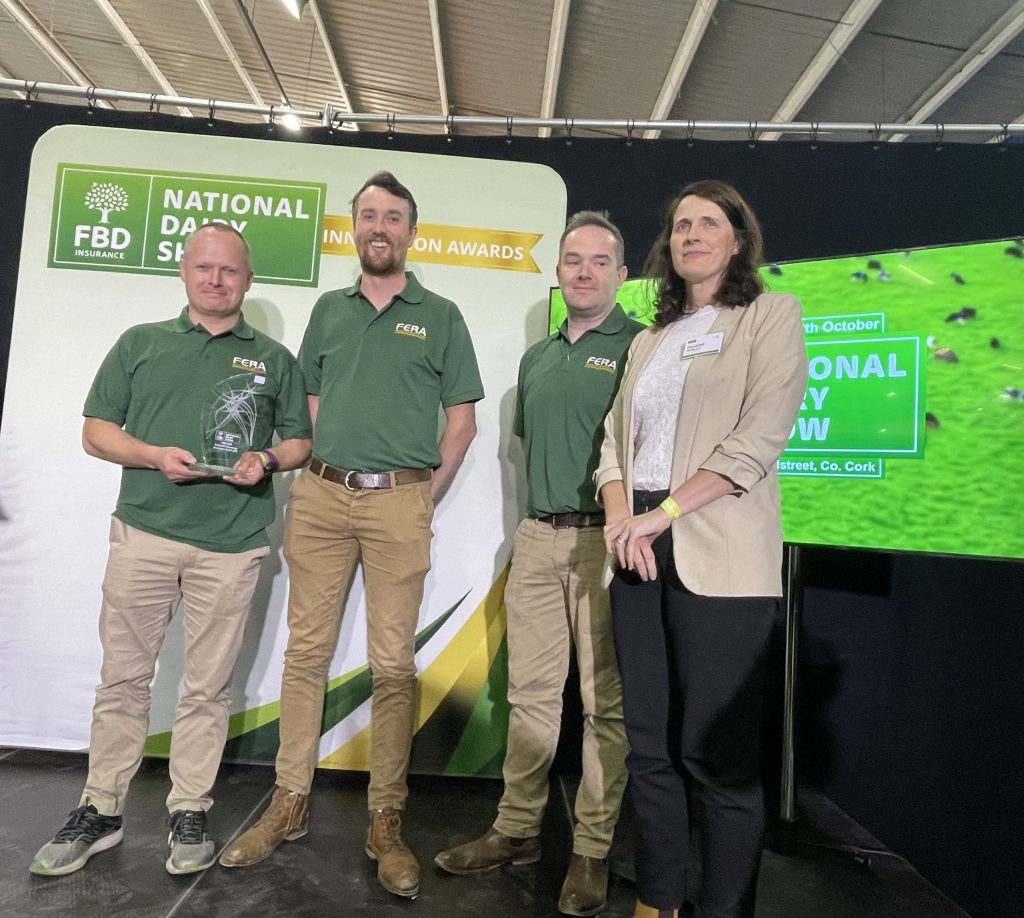
Udder Logic wins FBD National Dairy Show Innovation Awards
Beyond the trophy: what an automatic dip-and-flush system really costs, suits, and delivers for mastitis and SCC versus manual dipping.
It’s half six in the morning and you’re standing in the pit with a dip cup in one hand and a torch in the other, trying to get full coverage on teat four of cow 118 before she shifts her weight and you have to start again. Multiply that by 120 cows, twice a day, every day of the year, and you start to understand why an automated dipping system winning an award gets farmers’ attention fast.
Udder Logic took the overall innovation award at this year’s FBD National Dairy Show, along with the Engineering/Technology prize and Best Start Up, for its ADF system — a unit that automates post-milking teat disinfection and cluster flushing. That much has already been reported. What hasn’t been reported is the part that actually matters once the ceremony photos are put away: what does it cost to put one of these in your own parlour, does it fit your setup, and what can you realistically expect it to do to your cell count that a competent manual dipping routine isn’t already doing?
What it actually costs to get in the door
Here’s the uncomfortable truth: neither the award coverage nor the company’s own announcements put a price tag or a payback period on the ADF system, and that’s the single biggest gap for anyone trying to make a buying decision. Before you sign anything, insist on three numbers from any installer — the unit cost per cluster or per milking point, the retrofit labour charge for your specific parlour, and an estimated annual chemical and water spend. Automated dip-and-flush hardware of this type typically needs a chemical reservoir, delivery lines to each cluster, and a control unit tied into your existing milking plant, so the retrofit bill is rarely just the box price. Ask for a written payback estimate based on your own herd size and current mastitis treatment costs, not a generic industry figure — because without independent, published data on the ADF system’s running costs, any payback claim is only as good as the assumptions behind it.
Does it suit your parlour, or is it the wrong tool for your herd
Automated teat care hardware tends to make the most economic sense where the cost gets spread across more milking points and more milkings per year — larger herringbone and rotary parlours milking high cow numbers twice daily. On a small, low-cow-number herringbone parlour, the fixed cost of fitting delivery lines to every cluster is harder to justify against the labour it saves, because you’re still standing in the pit for most of the routine regardless. Research on Dutch herds using automatic milking systems found that farm-level hygiene and management factors were linked to average herd somatic cell count and the variance in cell count between test days — in other words, the technology on its own didn’t guarantee better udder health; how consistently it was managed and cleaned did. That’s a useful warning for anyone assuming a retrofit box fixes a hygiene problem by itself. If your current manual routine is patchy, automation helps most by removing that inconsistency — not by introducing some magic ingredient.
What’s genuinely new compared with the teat sprayers already out there
Automatic teat spraying robots have existed for years, mostly in robotic milking setups, spraying teats as cows exit. The distinguishing feature of an ADF-type system is pairing dip delivery with cluster flushing in the same automated step, inside a conventional parlour rather than only a robotic one. Whether that combination improves outcomes beyond what a good dip alone achieves isn’t something the award coverage addresses, and it’s worth being skeptical of marketing claims until independent trial data on this specific product exists. What the wider dipping research does tell us is that the chemistry of the dip matters less than you might expect. A controlled field trial comparing a foaming iodophor dip against a conventional iodophor with the same iodine content found no difference in new intramammary infection rates between the two groups (6.84% versus 9.16% in the first half of the trial, 7.78% versus 7.82% in the second) and no difference in clinical mastitis incidence. That suggests the real gains from automation are more likely to come from consistency and full coverage every single time, not from a cleverer formula in the reservoir.
What a good dipping routine — automated or not — can do to SCC
The clearest evidence that dipping itself matters comes from a trial on crossbred dairy cows that compared untreated controls against iodine, lactic acid, and essential oil dips. It found that post-milking teat dipping significantly reduced California Mastitis Test scores, somatic cell count, and milk electrical conductivity compared with no dipping, and also improved milk yield, with no meaningful difference between the individual dip types used. That’s a reasonably sized, if geographically specific, study — carried out under Indian sub-tropical conditions — and it tells you dipping works, full stop, regardless of which solution you use. Separately, smaller exploratory work on alternative disinfectants, including a probiotic lactic-acid-bacteria-based dip tested on just eleven Holstein-Friesian cows over twelve days, found somatic cell counts fell gradually through the cleaning protocol, with the probiotic group’s SCC slightly lower than the commercial disinfectant group — a promising but very early finding that needs much larger trials before anyone draws firm conclusions.
Maintenance, water, chemical use and the labour question
No published figures exist yet on litres of dip or water used per milking by the ADF system, or on cleaning and servicing intervals for the delivery lines — another real gap you should push any installer to fill in writing. What you can reasonably expect, based on how this hardware works in general, is daily labour time saved on the dipping step itself, offset against time spent monitoring reservoir levels, checking line blockages, and periodic servicing of pumps and nozzles. Ask specifically how often lines need flushing to prevent chemical residue build-up, because that maintenance burden is exactly the kind of detail that gets left out of award announcements but shows up in your Tuesday-morning routine six months after installation.
The takeaway: an award is a signal worth noting, not a business case. Before you commit, get a written cost and payback estimate for your own herd size and parlour type, ask what maintenance and chemical use the system actually demands, and treat any mastitis or SCC claims with the same scrutiny the published dipping research deserves — consistency of coverage, not the brand on the box, is what has reliably moved the needle in the studies that exist.
Sources
- The clinical effectiveness of a post milking teat disinfection method with a foaming iodophor teat dip (2003)
- Effect of post-milking teat dipping on milk quality and udder health of crossbred cows (2024)
- A Novel Lactobacilli-Based Teat Disinfectant for Improving Bacterial Communities in the Milks of Cow Teats with Subclinical Mastitis (2017)
- Farm-level risk factors for bovine mastitis in Dutch automatic milking dairy herds (2019)

Flock & Breeding Desk
Writing on breeding, lambing, nutrition and day-to-day flock management for Wiltshire Horn producers.